
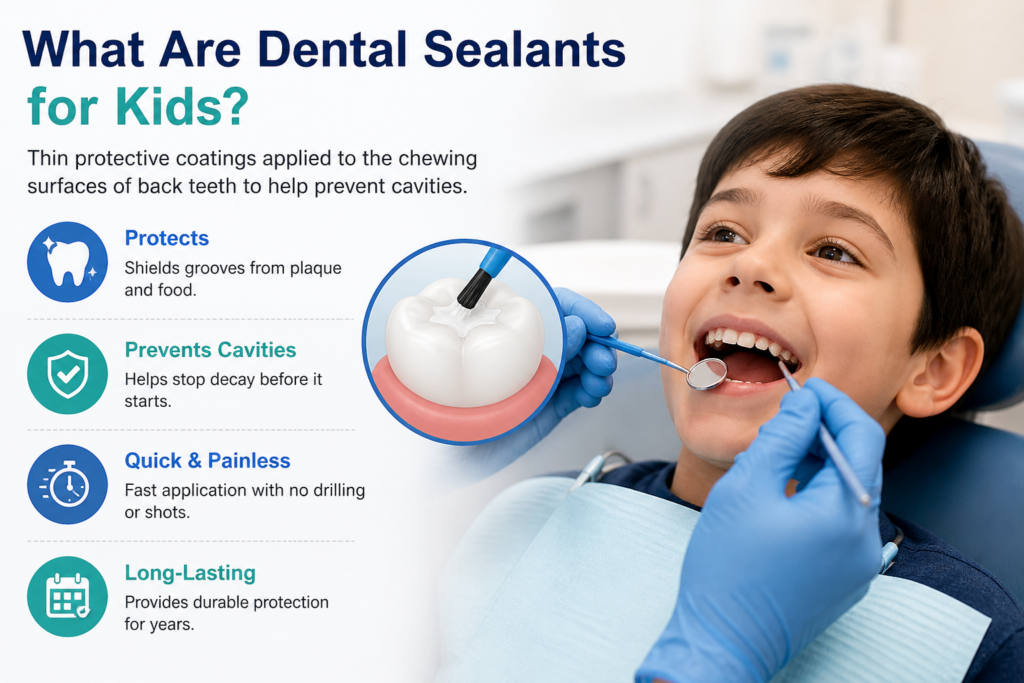
If your child’s dentist has recommended sealants and you’re not entirely sure what they are or whether they’re worth it, you’re in good company — it’s one of the questions we hear most often from parents at Czarkowski Pediatric Dentistry. Understanding what are dental sealants for kids makes it much easier to feel confident about the recommendation and to explain it to your child in a way that keeps them calm about the appointment.
A dental sealant is a thin, protective coating painted onto the chewing surfaces of the back teeth — the molars and premolars — to prevent food and bacteria from settling into the deep grooves where cavities most commonly form. The procedure is quick, completely painless, requires no drilling, and can significantly reduce your child’s risk of developing cavities in the teeth they’ll rely on for decades. Here’s everything parents need to know.
Dental Sealants Are a Thin Protective Coating That Shields the Grooves of Your Child’s Back Teeth
The back teeth — molars and premolars — have uneven chewing surfaces full of tiny pits and fissures. These grooves are excellent for grinding food, but they also create exactly the kind of protected, hard-to-clean environment where cavity-causing bacteria thrive. Even a child who brushes twice a day and flosses regularly can have toothbrush bristles that simply can’t reach the deepest parts of those grooves.
A dental sealant is a resin-based material — similar to a very thin plastic — that is applied as a liquid directly to the chewing surface of the tooth. It flows into those pits and fissures, then hardens to create a smooth, sealed surface. Once in place, the sealant physically blocks food particles and bacteria from sitting in the grooves between brushings. The tooth’s surface becomes easier to clean, and the conditions that lead to cavities are effectively eliminated in the treated areas.
Sealants are applied exclusively to the back teeth because those are the surfaces with deep anatomical grooves. The front teeth have smoother surfaces that are much less prone to the type of cavity that sealants prevent. In some cases, sealants may also be applied to baby teeth with particularly deep grooves — your child’s pediatric dentist will evaluate this on an individual basis.
Back Teeth Account for the Majority of Childhood Cavities — and Sealants Address That Directly
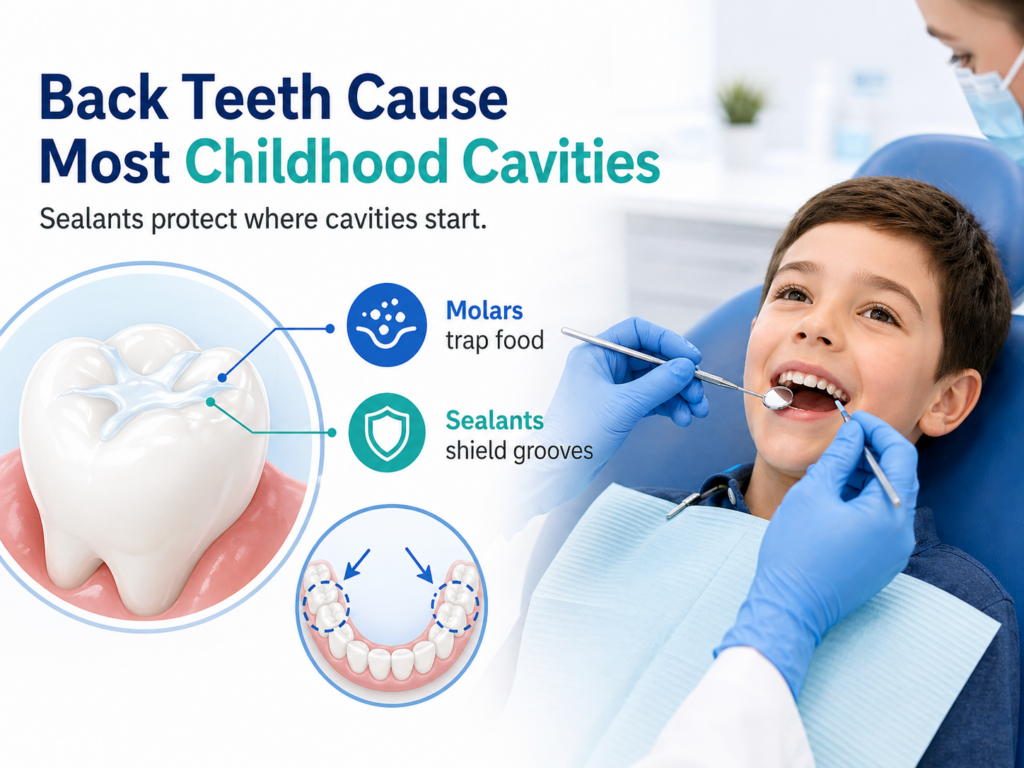
Cavities in the back teeth are by far the most common dental problem in school-age children. The Centers for Disease Control and Prevention (CDC) reports that tooth decay remains the most prevalent chronic childhood disease in the United States, and the chewing surfaces of molars are the most frequent site of new cavities in children and adolescents. This isn’t because children aren’t brushing — it’s because the anatomy of molars makes complete cleaning genuinely difficult, regardless of brushing technique or effort.
The research supporting sealants is well established. The CDC’s Community Preventive Services Task Force has found that school-age children without sealants have almost three times the number of first molar cavities compared to children who have them. The American Dental Association (ADA) and the American Academy of Pediatric Dentistry (AAPD) both recommend sealants as an effective preventive measure for children at risk of pit and fissure decay — which, given molar anatomy, includes virtually all children.
From a practical standpoint, a sealant application costs a fraction of what a filling costs — and it prevents the discomfort, appointment time, and potential anxiety that come with restorative treatment. For families focused on minimizing the number of dental procedures their child needs, sealants are one of the most cost-effective preventive investments available.
At What Age Should Kids Get Dental Sealants?
The timing of sealant application is tied to when your child’s permanent back teeth erupt, because the goal is to protect those teeth as soon as they come in — before there’s any opportunity for decay to develop. There are two primary windows for sealant placement in most children.
Around Age 6 — First Permanent Molars
The first permanent molars typically erupt around age 6, appearing behind the baby teeth at the back of the mouth. Many parents don’t realize these are permanent teeth because they arrive before any baby teeth have been lost. As soon as these molars are fully erupted and accessible, they are prime candidates for sealants. Placing sealants at this stage protects the teeth through the cavity-prone elementary school years, when sugar consumption tends to be high and brushing habits are still developing.
Around Age 12 — Second Permanent Molars
The second set of permanent molars erupts around age 11 to 13. These teeth should receive sealants as soon as they are fully in, extending protection through the teenage years. Many adolescents have diets high in carbohydrates and sugary drinks, and their brushing habits can be inconsistent — making this another high-risk window that sealants directly address.
Premolars and Individual Variation
Premolars — the teeth between the canines and molars — erupt between ages 10 and 12 and may also be candidates for sealants depending on their groove depth and your child’s individual cavity risk. Dr. Kara evaluates each tooth at regular checkups and recommends sealants based on the specific anatomy and risk profile of your child’s teeth, rather than applying a one-size-fits-all protocol.
Baby Teeth in Some Cases
In children with particularly deep grooves in their primary (baby) molars, or those at elevated cavity risk, sealants on baby teeth may be recommended. Baby teeth hold space for permanent teeth and support proper chewing and speech development — protecting them from decay matters even though they will eventually be replaced.
The Sealant Application Process Is Quick, Comfortable, and Completed in a Single Visit
One of the best things about dental sealants — especially for children who are anxious about dental procedures — is that the entire process is painless and involves no drilling, no shots, and no extended chair time. Most children are surprised by how easy the appointment is.
Here is what the sealant appointment looks like, step by step:
- Cleaning: The tooth is thoroughly cleaned and dried to ensure the sealant bonds properly to the enamel surface.
- Preparation: A mild acidic solution is applied to the chewing surface for a few seconds to create a slightly rough texture that helps the sealant adhere. This is rinsed off and the tooth is dried again.
- Application: The liquid sealant material is painted directly onto the tooth, flowing into the pits and grooves of the chewing surface.
- Curing: A small curing light is held over the tooth for a few seconds to harden the sealant into place.
- Check: Dr. Kara checks the bite to make sure the sealant doesn’t interfere with how the teeth come together, and makes any minor adjustments needed.
The entire process for a single tooth takes only a few minutes. Multiple teeth are often sealed in the same appointment. No anesthesia is required, and children typically report feeling nothing more than the mild taste of the sealant material. For children who are apprehensive about dental visits, knowing in advance that this appointment involves no needles and no drilling goes a long way toward keeping them calm.
How Long Do Dental Sealants Last — and How Do You Take Care of Them?
Dental sealants are durable but not permanent. With proper care, sealants typically last 5 to 10 years, providing protection through much of childhood and adolescence. The longevity depends on chewing habits, oral hygiene, and whether the sealant remains fully intact without chipping or wearing away.
At each regular checkup, Dr. Kara examines your child’s sealants as part of the routine exam. Sealants that have chipped, worn thin, or developed gaps can be repaired or reapplied as needed — keeping the protection in place as long as the teeth remain at risk for pit and fissure decay.
Tips for Making Sealants Last
- Avoid chewing on ice, hard candies, or other very hard foods that can chip the sealant material
- Continue regular brushing and flossing — sealants protect the chewing surfaces but do not cover the sides of teeth or the spaces between them, so good oral hygiene remains essential
- Keep up with regular dental checkups so sealant condition can be monitored at every visit
- Let Dr. Kara know if your child notices a sealant feels different or seems to have chipped between appointments
It’s also worth noting that sealants do not replace fluoride. Fluoride strengthens tooth enamel throughout the entire mouth, while sealants provide targeted physical protection in the grooves of specific teeth. Used together — along with good brushing habits and regular dental care — they are the most effective combination available for preventing childhood cavities.
Frequently Asked Questions About Dental Sealants for Kids
Are dental sealants safe for children?
Yes. Dental sealants have been used safely in children for decades and are endorsed by the American Dental Association, the American Academy of Pediatric Dentistry, and the Centers for Disease Control and Prevention. Some parents have questions about BPA, which is present in trace amounts in some resin-based sealant materials. The ADA has confirmed that the BPA exposure from dental sealants is extremely low — far below levels of concern — and is comparable to common everyday exposures. The proven benefit of preventing cavities significantly outweighs this minimal exposure risk.
Will my child feel anything during the sealant application?
No. The sealant procedure is completely painless and does not require any anesthesia, shots, or drilling. Your child may notice the taste of the sealant material and the brief sensation of the curing light, but there is no discomfort involved. We find that children who are nervous about dental visits are often pleasantly surprised by how simple this appointment is — and that positive experience can help build their confidence for future visits.
Do dental sealants mean my child doesn’t need to brush and floss anymore?
Not at all. Sealants protect the chewing surfaces of the back teeth — specifically the pits and grooves where cavities most commonly form — but they do not cover the smooth sides of teeth or the spaces between them. Cavities can still develop in unsealed areas if brushing and flossing are neglected. Think of sealants as one important layer of protection that works best when combined with good daily oral hygiene and regular professional cleanings.
Are dental sealants covered by insurance?
Many dental insurance plans cover sealants for children, typically up to a certain age — often 14 or 16 — and on permanent molars. Coverage details vary by plan, so it’s worth checking with your insurer before the appointment. Our team at Czarkowski Pediatric Dentistry is happy to help you understand your coverage and discuss financial options if you have questions about costs.
Can sealants be placed over a tooth that already has a small cavity?
In some cases, yes. If a tooth has very early-stage decay that is limited to the enamel surface and has not yet progressed to the point of needing a filling, a sealant can be placed over the affected area to arrest further decay progression. Dr. Kara evaluates this on a case-by-case basis using clinical examination and X-rays. Sealants should never be placed over decay that has reached the dentin layer — that requires restorative treatment first.
Sealants Are One of the Simplest, Most Effective Things You Can Do for Your Child’s Dental Health
Preventing a cavity is almost always better than treating one — for your child’s comfort, for their experience at the dentist, and for your family’s budget. Dental sealants give back teeth a layer of protection that brushing and flossing alone can’t fully provide, and they do it in a quick, painless appointment that most children handle easily.
At Czarkowski Pediatric Dentistry, Dr. Kara takes a personalized approach to every child’s preventive care — evaluating sealant candidacy based on tooth anatomy, eruption timing, and individual cavity risk rather than a one-size-fits-all checklist. If your child is approaching the age when their first permanent molars are coming in, or if you have questions about whether sealants are right for your child, we’d love to talk it through with you. Contact our Indianapolis office to schedule an appointment or ask us anything at your child’s next visit — healthy smiles really do start here.